Aenak · AC Quilts & Razai
Jaipuri Razai (रज़ाई) — Handblock Printed, Mulmul Cotton, Light Enough for AC Rooms
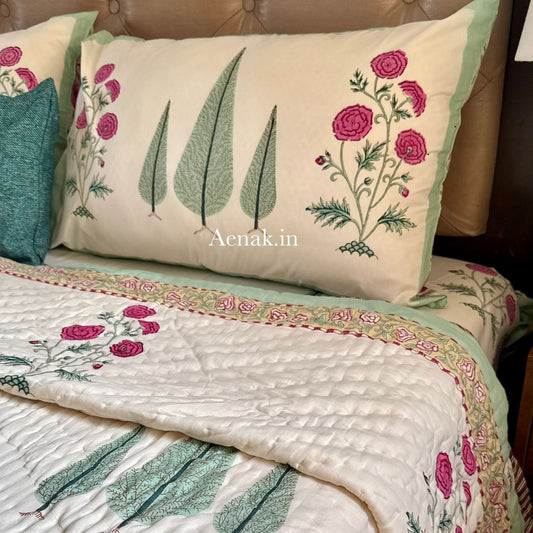
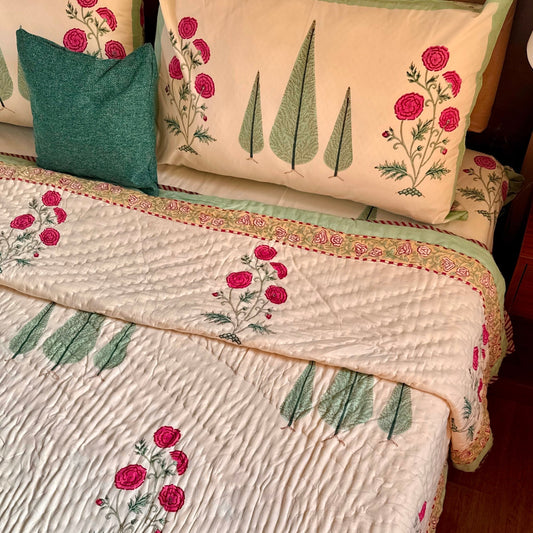
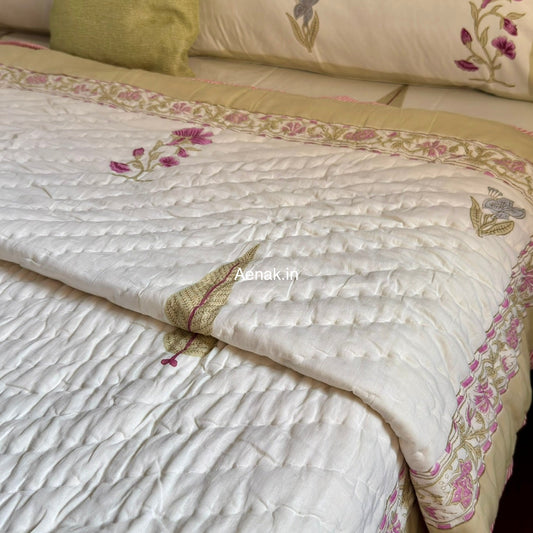
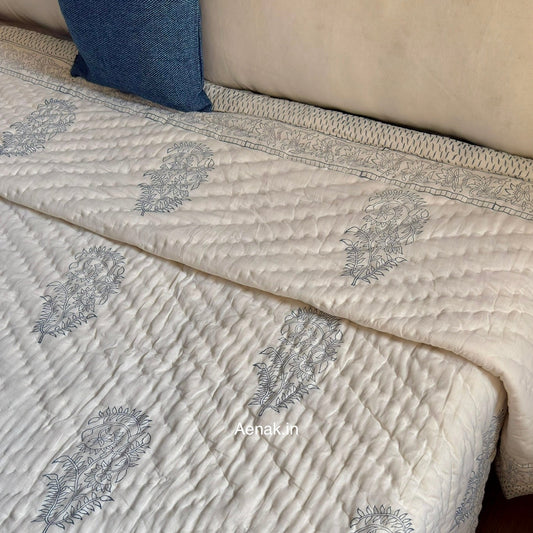
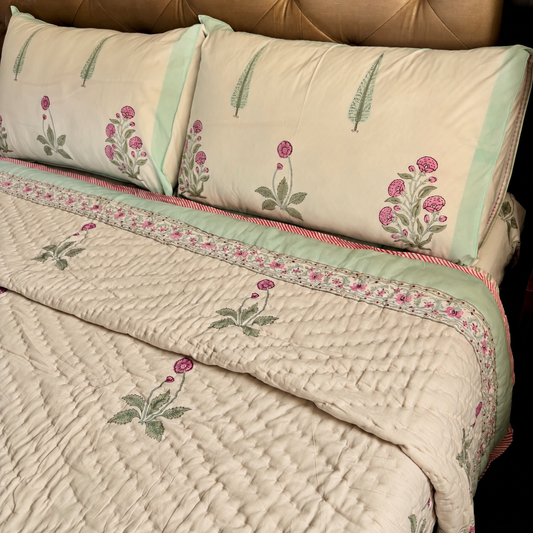
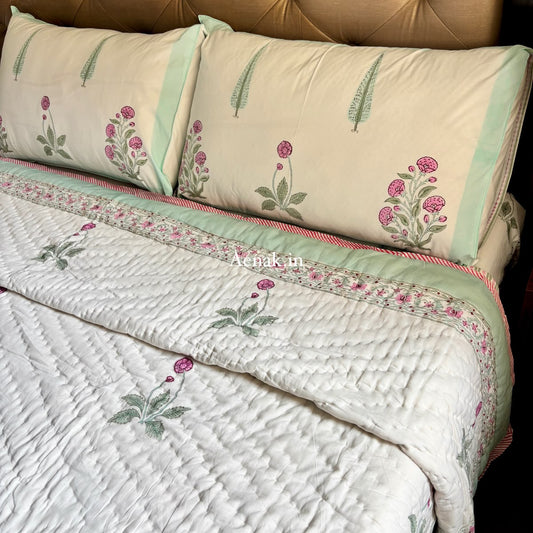
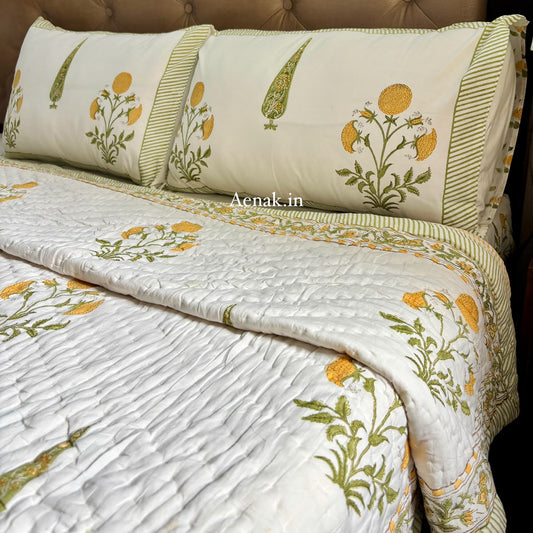
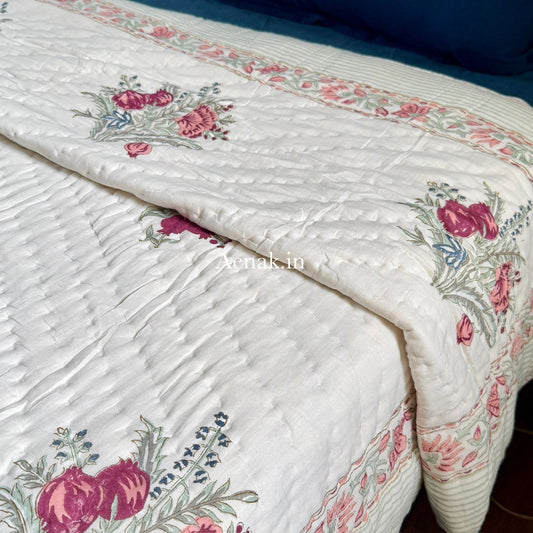
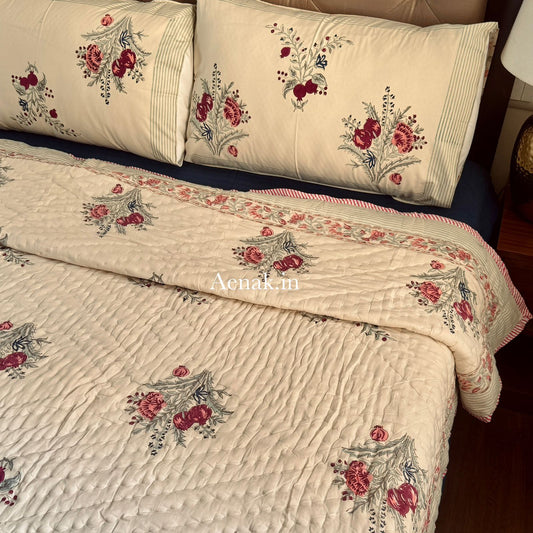
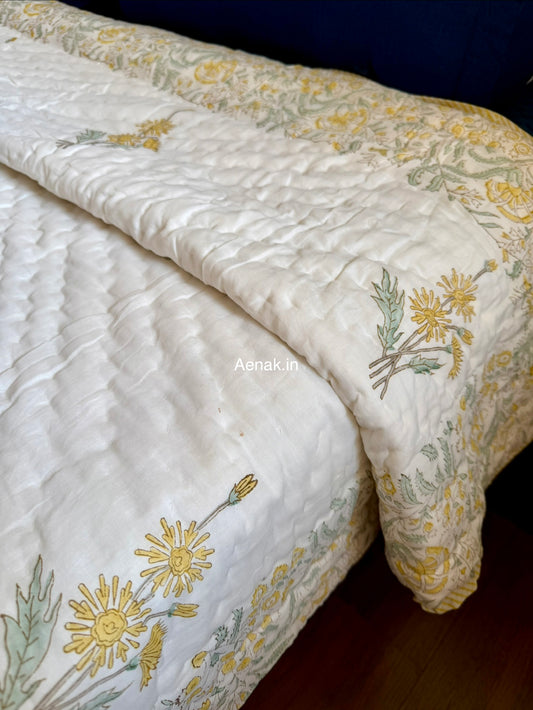
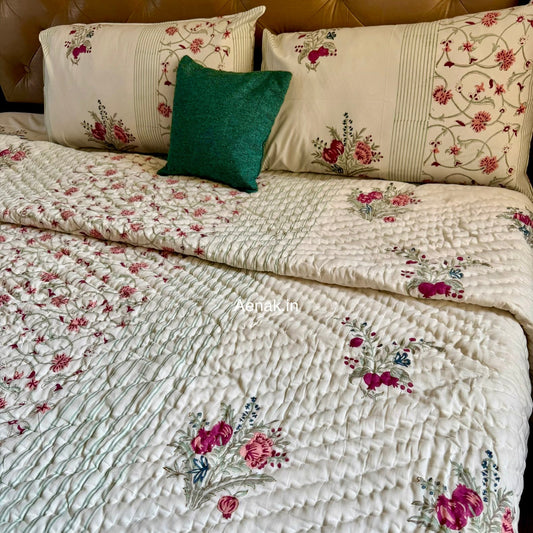
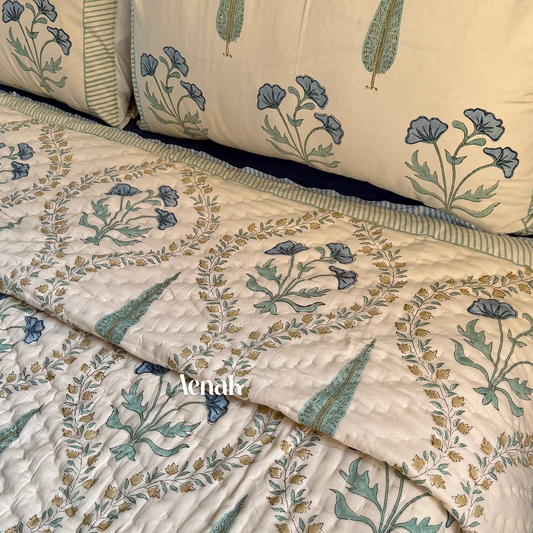
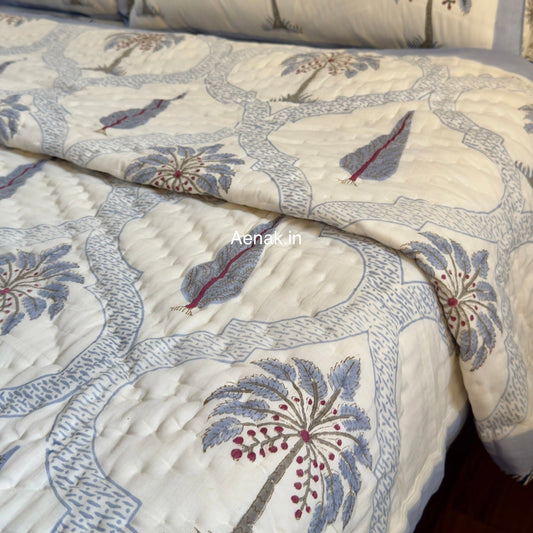
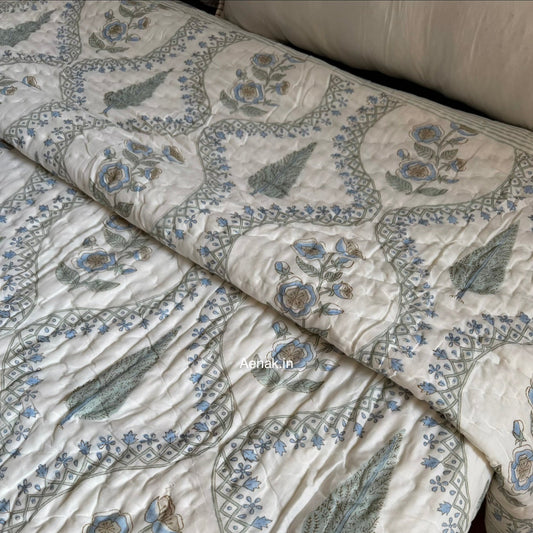
When the AC kicks in and the room turns cool, you need a razai that wraps you in warmth without weighing you down. Aenak's Jaipuri Razai — also called AC quilt, AC rajai, or simply rjai (रजाई) — is handblock printed by Chippa artisans in Sanganer, Jaipur, in light mulmul cotton. Not the heavy shaneel razai of harsh winters. The perfectly calibrated Jaipuri rajai for Indian AC rooms and mild winters, available in single bed, double bed, and king size.
15–22°C
Ideal temperature range — AC rooms & mild winters
100%
Cotton shell — mulmul outer, natural fill
400+
Years of Sanganeri handblock tradition
3 sizes
Single, Double/King, Single Set of Two
Custom
Heavier fill for harsh winters — make to order
What Is a Razai (रज़ाई)? — The Jaipuri Quilt Explained
Razai / Rajai — Quick Definition
A razai (रज़ाई) — also written as rajai (रजाई) — is a traditional Indian quilt: two layers of fabric stitched together with cotton filling (rui) between them. The word razai is used across North India, particularly in Rajasthan, UP, Delhi, and Punjab. A Jaipuri razai (also called Jaipuri rajai) is a razai made in the Jaipur tradition — using hand-carded cotton fill and, in Aenak's case, a handblock printed mulmul cotton outer shell from Sanganer artisans. The Aenak Jaipuri razai is specifically a light-fill AC razai — designed for air-conditioned rooms and mild winters, not the heavy shaneel or fibre rajai used in harsh North Indian winters.
Razai · Rajai · AC Quilt · What You're Looking For
Aenak's collection is India's finest selection of handblock printed Jaipuri razai. Whether you call it razai (रज़ाई), rajai (रजाई), AC rajai, Jaipuri quilt, mulmul razai, cotton razai, light razai, single bed razai, double bed razai, or simply the Jaipur razai — you have found it. Every razai in this collection is made from 100% mulmul cotton outer shell, printed by Chippa artisans in Sanganer, filled with premium light-weight cotton, and stitched by hand. Available in single rajai, double rajai / king razai, and a single set of two rajai. Heavier fill razai for harsh winter also available — make to order.
The distinction between an AC razai (or AC rajai) and a heavy winter razai matters more than most buyers realise before they purchase. India's bedding market is full of heavy razais designed for Rajasthan's December nights or Himachal Pradesh winters — filling that is simply too warm for an AC room at 20–22°C. Sleeping under a heavy shaneel razai in an air-conditioned bedroom produces the same problem as sleeping under it in summer: the fill traps heat and you end up sweating. An AC razai or lightweight rajai is engineered for the specific Indian problem of mild-to-cool temperatures — where you need something over you, but not much.
The Aenak Jaipuri razai is the precise solution: light cotton fill (not fibre, not shaneel, not heavy rui) in a mulmul cotton shell, handblock printed in Sanganeri tradition. Warm enough to sleep comfortably at 15–22°C. Light enough not to cause the 2 AM kick-off that happens with heavier razais. Beautiful enough to use as the top visible layer of the bed without a bedcover.
Why the Aenak Jaipuri Razai — What Makes It Different
🌿 Mulmul Cotton Shell — Not the Synthetic Cover Most Razais Use
The outer shell of every Aenak razai is made from mulmul (muslin) cotton — the finest, most breathable natural cotton fabric. Most commercially available razais use synthetic outer fabric — polyester or nylon — to reduce cost. Synthetic shell fabrics look similar to cotton on initial inspection but feel significantly different against skin: less breathable, warmer, and with a faint synthetic smell that natural cotton never has. The mulmul cotton shell on every Aenak razai is breathable, skin-friendly, and the reason the razai can be used directly against skin without a liner bedsheet — the way a truly good razai is meant to be used.
🖐️ Sanganeri Handblock Print — Both Sides, Same Design
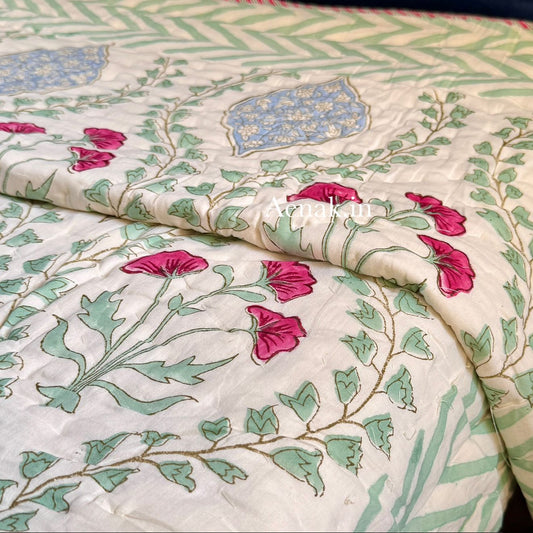
Every Aenak Jaipuri razai is handblock printed by Chippa artisans in Sanganer, Jaipur — India's 400-year-old handblock printing capital. The same hand-carved teak blocks pressed onto mulmul cotton, one impression at a time, that produce Aenak's bedsheets. The razai is printed on both sides — reversible, with the block print on each face. Slight variations between impressions are the mark of authentic handblock work, not a defect. No other razai at this price point is made by the same craft standard.
☁️ Light Cotton Fill — The Right Fill for AC India
The fill in an Aenak AC razai is premium light-weight cotton — hand-carded in the Jaipuri tradition. Not fibre fill (polyester batting, which traps heat), not shaneel (woollen pile, heavy and hot), not heavy rui (the dense cotton used in traditional winter razais). Light cotton fill provides the warmth of a razai without the weight that makes heavy razais uncomfortable in AC rooms. The standard Aenak razai is calibrated for 15–22°C. For heavier fill — for those who need a Jaipuri razai for heavy winter below 15°C — make-to-order heavier fill is available on request.
🎨 Azo-Free Dyes — Skin-Safe for 8 Hours of Contact Every Night
A razai is in contact with skin for 7–9 hours every night — making dye safety more important for a razai than for almost any other textile. All Aenak razais use azo-free dyes — certified free of the harmful aromatic amines that certain synthetic dyes can release. Safe for extended daily skin contact, including for children sharing the bed. The vivid, rich colours of the handblock prints across the Aenak razai collection are all achieved within the azo-free standard.
🔄 Reversible Design — Two Looks, One Razai
Every Aenak Jaipuri razai is printed on both sides — two distinct colourways of the same handblock design, one on each face. Flip the razai to change the bedroom's look. The reversible design also extends the interval between dry cleaning — alternate between faces between cleans, giving each face half the soil exposure. A Jaipuri rajai that is visually different on each side is also more interesting to live with — the bed looks different depending on which side faces up, without changing anything else in the room.
📦 Easy to Store — Folds Compactly for Seasonal Use
The light cotton fill means an Aenak AC razai folds compactly — a double/king razai fits in a standard shelf or drawer when not in use. This makes rotating between a razai and a dohar between seasons practical: the razai stores easily when the dohar takes over in summer, and the dohar stores equally easily when the razai returns in winter. A lightweight Jaipuri rajai is not just a better AC razai — it is a more manageable one.
Razai Temperature Guide — Which Razai for Which Warmth
The most common razai buying mistake in India: choosing a razai based on how it looks in a photograph rather than how warm it is for your actual sleeping environment. Here is the precise temperature guide for the Aenak razai range.
Aenak Mulmul Dohar
18–35°C — Warm rooms, coastal India, AC at 22–24°C
Not a razai — a three-layer mulmul cotton dohar with thin flannel fill. Lighter than any razai. Ideal when you want coverage but very little warmth. If your AC room rarely drops below 20°C, or if you sleep warm, the dohar is the better choice. See the Dohars collection for the Aenak dohar range.
Aenak AC Razai (This Collection) ← Most Popular
15–22°C — AC rooms at 18–22°C, mild winters across India
The standard Aenak Jaipuri razai with light cotton fill. The right choice for AC rooms set between 18–22°C, for South and coastal Indian winters (which rarely drop below 15°C), and for North Indian transitional months (October–November, February–March). The single most versatile razai for Indian sleeping conditions — covering the scenario most Indian adults actually sleep in.
Heavier Fill Razai — Make to Order
8–15°C — North Indian peak winter, hill stations, colder climates
For those who need a Jaipuri razai for heavy winter — temperatures below 15°C in Delhi, Jaipur, Lucknow, Chandigarh, or any hill station. The heavier fill razai uses the same mulmul cotton shell and handblock print as the standard AC razai; only the inner fill weight changes. This is a make-to-order piece. Contact us on WhatsApp +91-9136167510 with your fill weight preference and lead time.
Quick Decision — AC Razai or Heavier Razai?
If your city is Mumbai, Chennai, Bengaluru, Pune, Hyderabad, Kochi, or coastal India: The standard AC razai is the only razai you need, year-round.
If your city is Delhi, Jaipur, Lucknow, Chandigarh, Patna: The standard AC razai covers October through March comfortably for most people. If you are a cold sleeper or your home gets below 12°C at night in December–January, order the heavier fill via WhatsApp.
If you are at a hill station or above 1,500m elevation: Heavier fill only — the AC razai will not be sufficient.
Razai vs Rajai vs Dohar vs Comforter — Which Is Which?
Indian bedding terminology is used inconsistently across regions — razai and rajai are the same object (razai is the more common Urdu-influenced spelling; rajai is the more common Hindi spelling, particularly in Rajasthan and UP). A dohar is different from a razai. A comforter is different from both. Here is the clear comparison.
| Bedding |
Fill |
Weight |
Best for |
Washable? |
| Mulmul Dohar |
Thin flannel (falalen) |
Under 400g |
Summer, coastal year-round, AC 20–24°C |
Machine wash ✓ |
| Aenak AC Razai / AC Rajai This collection
|
Light cotton rui |
800g–1.2kg |
AC rooms 15–22°C, mild winters |
Dry clean only |
| Heavy Jaipuri Razai (make to order) |
Heavier cotton rui |
1.5–2kg |
North Indian peak winter, below 12°C |
Dry clean only |
| Shaneel Razai |
Synthetic fibre or woollen pile |
2–3kg |
Very cold nights, hill stations |
Dry clean only |
| Comforter / Duvet |
Polyester or down |
1.5–2.5kg |
Western climates — too warm for most of India |
Machine wash (usually) |
Razai vs rajai — are they different? No — razai (رضائی) and rajai (रजाई) refer to the same object. Razai is the more common spelling in urban India and in Urdu; rajai is the more common spelling in Rajasthani and Hindi usage, particularly in UP, Rajasthan, and Bihar. A Jaipuri razai and a Jaipuri rajai are the same product. At Aenak, we use razai and rajai interchangeably throughout our range.
What is the difference between a mulmul razai and a cotton razai? A mulmul razai uses mulmul (muslin) cotton for the outer shell — the finest, most breathable natural cotton, at 50–80 GSM. A cotton razai uses standard cotton (100–140 GSM) for the outer shell. Both use cotton fill (rui). The mulmul outer shell makes the razai lighter to touch, softer against skin, and more breathable — which is why the Aenak Jaipuri razai uses mulmul cotton rather than standard cotton for the outer layers.
The Craft — Jaipuri Handblock Printing on Mulmul Cotton
Jaipur's association with razai-making is one of India's oldest textile stories. The city's artisan communities — Chippa printers in Sanganer, dhunki craftsmen who card and fill the cotton — have been producing quilts and razais for Mughal courts and then for Indian households for centuries. The "Jaipuri razai" is not a marketing term. It is a specific product tradition rooted in specific artisan skills.
At Aenak, the Jaipuri razai production involves two specialist crafts: the Chippa artisans who handblock print the mulmul cotton shell in Sanganer (the same artisans who print Aenak's bedsheets, dohars, and bedcovers), and the dhunki craftsmen who hand-card the cotton filling into an even, flat layer before it is enclosed in the shell. Hand-carded cotton fill distributes more evenly than machine-processed batting — the warmth is consistent across the full surface of the razai rather than thinner at the edges where batting tends to migrate.
What Makes a Jaipuri Razai Authentic
Three craft elements distinguish an authentic Jaipuri razai from a commercially manufactured quilt sold as "Jaipuri": (1) Handblock printed outer shell — pressed block by block by a Chippa artisan, not screen-printed or digitally printed fabric printed to look like handblock. (2) Hand-carded cotton fill — cotton rui beaten and carded by hand (by the dhunki craftsman using the dhunki bowing tool), not machine-processed polyester batting. (3) Sanganer or Bagru origin — printed in the actual artisan communities near Jaipur, not a factory in Surat printing "Jaipuri-style" designs. Every Aenak razai meets all three criteria.
Razai Size Guide — Single, Double, King, and Set of Two
Double / King Razai — Most Popular
90 × 108 inches (229 × 274 cm)
The standard double bed razai / king razai size — fits Indian double beds and most king-size beds (mattresses up to approximately 60×78 inches). Generous drape on all sides. The most popular size in the Aenak razai range — the double bed razai (or Jaipuri razai double bed) is the most searched size across India and the most gifted. Comes with a matching pillow cover when purchased as part of the bedsheet + razai combo set.
Single Bed Razai
60 × 90 inches (152 × 229 cm)
For single beds, children's beds, guest rooms, and solo sleepers. The single razai is also appropriate as a sofa throw or a travel quilt for hill station trips. Many North Indian households keep two single razais for a couple rather than one shared double razai — allowing each person to adjust their own coverage without disturbing the other.
Single — Set of Two Razais
2 × Single (60 × 90 inches each) — same handblock print
Two single razais in the same Sanganeri design — the rajai set for couples who prefer individual covers. Particularly popular in homes where the two sleepers have different warmth preferences (one warm sleeper and one cold sleeper can use different fill weights, one from the AC razai range and one from the heavier fill make-to-order range). Also a strong gifting configuration for weddings and anniversaries.
Heavier Fill — Make to Order
Available in Single or Double/King — same shell and print
For those who need a Jaipuri razai for heavy winter — temperatures consistently below 15°C. Same mulmul cotton shell, same Sanganeri handblock print, same sizes — only the inner fill weight is increased. Contact us on WhatsApp +91-9136167510 to specify your fill weight preference and we will confirm lead time (typically 15–20 days for make-to-order).
City & Season Guide — Which Razai for Where You Live
India's climate varies so dramatically that the right razai in Mumbai is genuinely different from the right razai for Delhi. Here is the city-specific guide to choosing the correct Aenak razai for your sleeping environment.
Mumbai · Chennai · Kochi · Goa · Bhubaneswar
Standard AC Razai — year-round use
Coastal cities rarely drop below 20°C even in January. The standard Aenak AC razai is the right choice year-round — for AC rooms at 20–22°C through summer, and for the mild winters that coastal India calls "cold." The dohar covers the warmest months; the AC razai takes over from approximately October. Some coastal households use the AC razai all year.
Bengaluru · Pune · Hyderabad · Ahmedabad
Standard AC Razai — October through March
These cities have a genuine but mild winter. The AC razai covers the cool months (October–March) comfortably. For Bengaluru's mildest winter nights (12–15°C, December–January), the standard fill is usually sufficient for most sleepers — warm sleepers may find the dohar adequate even in January; cold sleepers in Bengaluru may want to layer an additional blanket over the AC razai in the coldest weeks.
Delhi · Jaipur · Lucknow · Chandigarh · Agra
Standard AC Razai (October–November, February–March) + Heavier Fill (December–January)
North India has the most demanding winter in India's plains. The standard AC razai covers the transitional months comfortably. For peak winter (December–January, when temperatures can drop to 5–10°C at night), most North Indian households want a heavier razai — either the make-to-order heavier fill Aenak razai, or a heavier winter quilt layered over the AC razai. The classic North Indian configuration: a light AC rajai for most of the year, a heavy rajai for peak winter.
Kolkata · Patna · Varanasi · Bhopal · Indore
Standard AC Razai — November through February
Central and East Indian cities have a moderately cold winter (12–18°C at night in December–January) that the standard AC razai handles well for most sleepers. Cold sleepers or those in older homes without insulation may find the make-to-order heavier fill more comfortable for the coldest weeks.
Hill Stations · Above 1,500m Elevation
Heavier Fill Razai — make to order only
For hill stations (Shimla, Mussoorie, Ooty, Darjeeling, Coorg) and any location consistently below 10°C at night, the standard AC razai fill is insufficient. Only the make-to-order heavier fill razai is appropriate. Contact us on WhatsApp +91-9136167510 to discuss fill weight and lead time for a heavier Jaipuri razai for hill station use.
Care Instructions — How to Care for a Jaipuri Razai
A Jaipuri razai cared for correctly will last 5–8 years and maintain its fill distribution and shell quality throughout. The single most important rule: never machine wash the razai.
🧼 Dry Clean Only — Professional Care for the Fill
The razai must not be machine washed. Machine washing damages the hand-carded cotton fill — the even distribution of fill that gives the razai its consistent warmth is permanently disrupted by machine agitation. The cotton fill clumps and compresses, creating cold patches and uneven weight. Take it to a trusted dry cleaner and inform them it has a natural dye mulmul cotton shell so they use appropriate solvents. Dry cleaning every 4–8 weeks during regular use maintains hygiene without damaging the fill.
🫧 Surface Spot Cleaning — Between Dry Cleans
For surface spots or light soiling between dry cleans, use a damp cloth with mild soap and gently dab — do not rub and do not soak the fabric. Allow to air dry completely in shade before using the razai again. Do not wring, twist, or tumble dry under any circumstances.
☀️ Air in Indirect Sunlight Regularly
Air the razai in indirect sunlight once every 1–2 weeks during regular use — this keeps the fill fresh, prevents moisture from accumulating inside the fill layers, and helps maintain the fill's loft. Do not hang in direct harsh sunlight for extended periods, which can fade the natural dye colours over time.
📦 Storage Between Seasons
Store in a breathable cotton bag or muslin cover — never in plastic, which traps moisture and can cause the natural cotton fill to develop odour or mildew over months of storage. Store loosely rather than compressed — compression over months can flatten the cotton fill permanently. Before storing for summer, ensure the razai has been dry cleaned and is completely dry.
🔄 Flip Regularly — Use Both Sides
Because the Aenak razai is reversible, alternate between sides between dry cleaning visits. This distributes wear and soil exposure evenly across both faces, extending the time between necessary dry cleans. The two sides of a reversible razai used alternately will each need dry cleaning half as frequently as a single-sided razai would.
⚠️ Note for New Razais — First Use
A new Aenak razai may have a faint natural cotton or dye smell — this is completely normal for a freshly printed mulmul cotton product and dissipates within a few days of airing. Air the razai outdoors in shade for a few hours before first use. The natural dye smell (if present) is not an indication of excess chemical — it is the smell of fresh natural textile production.
The Aenak Jaipuri Razai — What Every Piece Guarantees
100% mulmul cotton shell — no synthetic outer fabric · Azo-free dyes — certified skin-safe for 8 hours of nightly contact · Sanganeri handblock print by Chippa artisans, Sanganer, Jaipur · Reversible — same block print on both faces · Hand-carded cotton fill — light weight for AC rooms 15–22°C · Available in Single (60×90 in), Double/King (90×108 in), Single Set of Two · Make-to-order heavier fill for temperatures below 15°C · Dry clean only — fill lasts 5–8 years with correct care · Free shipping across India
Frequently Asked Questions — Jaipuri Razai & AC Quilt
What is a razai? What is the difference between razai and rajai?
A razai (रज़ाई) is a traditional Indian quilt — two layers of fabric stitched together with cotton filling (rui) between them. It is the primary winter sleeping cover across North India, particularly in Rajasthan, UP, Delhi, Punjab, and Bihar. Razai and rajai (रजाई) are the same object — razai is the more common Urdu-influenced spelling used in urban and formal contexts; rajai is the more common Hindi spelling, particularly in Rajasthan and UP usage. A Jaipuri razai (or Jaipuri rajai) is a razai made in the Jaipur tradition, using hand-carded cotton fill and — in Aenak's case — a handblock printed mulmul cotton shell.
What is a mulmul razai? How is it different from a regular cotton razai?
A mulmul razai uses mulmul (muslin) cotton for the outer shell — the finest natural cotton fabric, woven at 50–80 GSM. This makes the shell lighter, softer, and more breathable than standard cotton (100–140 GSM). Both use cotton fill (rui) inside. The mulmul outer shell makes the razai more comfortable against skin, particularly for those who use the razai directly without a top bedsheet. Aenak uses mulmul cotton for the outer shell on all its razais.
What temperature is the Aenak AC Razai suitable for?
The standard Aenak AC razai is designed for 15–22°C — air-conditioned rooms, South and coastal Indian winters (year-round in some cities), and North Indian transitional months (October–November and February–March). For temperatures consistently below 15°C — North Indian peak winter (Delhi, Jaipur, Lucknow, Chandigarh in December–January) — a heavier fill razai is needed. Aenak offers heavier fill razais as make-to-order pieces: WhatsApp +91-9136167510 to discuss fill weight and lead time.
What is the difference between a razai and a dohar?
A razai (रज़ाई) has a thicker cotton fill (rui) that provides genuine warmth — designed for cool to cold temperatures from 15°C downwards. A dohar (दोहर) has a much thinner flannel fill and is not quilted — lighter, more breathable, designed for summer and AC rooms at 18–28°C. For Indian summers and AC rooms at 20–24°C: the dohar is the better choice. For Indian winters and AC rooms at 15–20°C: the razai is the better choice. Many Indian households own both — a dohar for summer, a razai for winter — rotating between them seasonally.
Can I machine wash the razai?
No — the razai is dry clean only. Machine washing permanently damages the hand-carded cotton fill: the agitation disrupts the even distribution of the fill, causing it to clump and compress, creating cold patches and uneven weight across the razai. The natural dye mulmul cotton shell can also run unevenly in machine washing. For light surface soiling between dry cleans, dab gently with a damp cloth and mild soap — do not soak. Air the razai in indirect sunlight regularly between dry cleans to keep it fresh.
What sizes are available? What is the right size for a double bed?
Available in: Double/King (90×108 inches — fits most Indian double and king beds with comfortable drape), Single (60×90 inches — for single beds, solo sleepers, and children's beds), and Single Set of Two (two single razais in the same design — for couples who prefer individual covers). For a standard Indian double bed (mattress approximately 60×72 or 60×78 inches), the Double/King size (90×108 inches) is the correct choice — it provides 15+ inches of drape on each side. Custom sizes and heavier fill options available via WhatsApp +91-9136167510.
I want a heavier razai for harsh winters. Is that available?
Yes — Aenak offers heavier fill razais as make-to-order pieces. The same mulmul cotton shell and Sanganeri handblock print; only the inner cotton fill weight is increased for more warmth below 15°C. Available in single and double/king sizes. Contact us on WhatsApp +91-9136167510 to specify your required fill weight (or simply your city and the coldest overnight temperature you typically experience), and we will advise on the right fill. Make-to-order heavier fill razais typically take 15–20 days from order to delivery.
What is Sanganeri handblock printing on the razai?
Sanganeri printing is a 400-year-old Indian textile craft from Sanganer near Jaipur. Chippa artisans carve intricate floral and geometric motifs — buti, buta, bel, jaal — into teak wood blocks and press them onto mulmul cotton fabric one impression at a time using azo-free dyes. Every Aenak razai shell is printed this way before the razai is assembled. Slight variations between impressions are natural — they are the mark of authentic handblock work, distinguishing genuine Jaipuri razais from factory-produced quilts with machine-printed Jaipur-style designs.
Is the razai reversible? What does that mean?
Yes — every Aenak Jaipuri razai is printed on both sides with the same Sanganeri handblock design in two complementary colourways. Flipping the razai over gives a different colour direction — the same motifs in a different palette. Using the razai reversibly extends time between dry cleans (each face accumulates soil at half the rate), and gives the bedroom a different look without changing anything else. A reversible Jaipuri rajai is effectively two razais in one.
What is the difference between an AC razai and a shaneel razai?
A shaneel razai uses shaneel fabric (a synthetic or woollen pile fabric) on the outer shell — this is the heavy, fuzzy-surfaced razai sold in North Indian markets for peak winter. It is significantly heavier and warmer than an AC razai. Shaneel razais are appropriate for temperatures below 10°C but are too hot and too heavy for AC rooms and mild winters. The Aenak AC razai uses mulmul cotton for the shell (not shaneel) and a light cotton fill — designed for AC rooms and mild winters, not the same use case as a shaneel razai.
How should I store the razai between seasons?
After the winter season, dry clean the razai before storage. Store in a breathable cotton bag or muslin pouch — never plastic, which traps moisture and can cause mildew in the natural cotton fill over months. Store loosely (do not compress) to preserve the fill's loft. Keep in a cool, dry place away from direct sunlight. Before using the razai again next season, air it in indirect sunlight for a few hours to freshen the fill and fabric.